in Ruminants
Overview
- Fasciola hepatica, the most important trematode of domestic ruminants, is the most common cause of liver fluke disease in temperate areas of the world
Life cycle
Pathogenesis
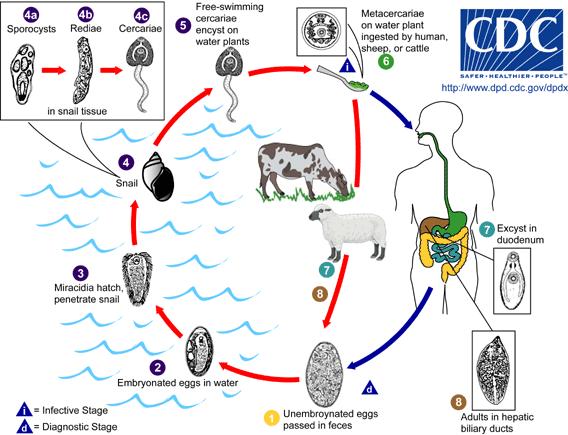
- Eggs are passed in the feces, and miracidia develop within as little as 9–10 days (at 22°–26°C [71.6°–78.8°F]; little development occurs below 10°C [50°F]). Hatching only occurs in water, and miracidia are short-lived (~3 hr). Miracidia infect lymnaeid snails, in which asexual development and multiplication occur through the stages of sporocysts, rediae, daughter rediae, and cercariae. After 6–7 wk (or longer if temperatures are low), cercariae emerge from snails, encyst on aquatic vegetation, and become metacercariae. Snails may extend the developmental period by hibernating during the winter. Metacercariae may remain viable for many months unless they become desiccated.
- After ingestion by the host, usually with herbage, young flukes excyst in the duodenum, penetrate the intestinal wall, and enter the peritoneal cavity, where they migrate to the liver. The time required for this transit can vary and results in delayed development rates, which affects the efficacy of some treatments because many are effective against flukes only later in their development. The young flukes penetrate the liver capsule and tunnel through the parenchyma for 6–8 wk, growing and destroying tissue. They then enter small bile ducts and migrate to the larger ducts and, occasionally, the gallbladder, where they mature and begin to produce eggs. The prepatent period is usually 2–3 mo, depending on the fluke burden. The minimal period for the completion of one entire life cycle is ~17 wk. Adult flukes may live in the bile ducts of sheep for years; most are shed from cattle within 5–6 mo.