Short questions gathered from my notes, grouped by species and subject. Pick an answer to check it, then read the explanation. For longer case vignettes, see Clinical cases.
Equine
Radiographic signs of chronic laminitis
Radiographic abnormalities associated with chronic laminitis in horses include which of the following?
Answer and explanation
Answer: a change in the angulation of P3.
Inflammation and degeneration of the lamina can be seen radiographically as rotation of P3 relative to the hoof. Osteophyte formation is not an indication of laminitis. A distinct lucent line is normally seen between the margin of P3 and the hoof on the lateral view of a foot.
Predisposing factors for equine laminitis
Which of the following is not considered a predisposing factor to a horse developing laminitis?
Answer and explanation
Answer: application of horse shoes.
Laminitis is an inflammatory condition of the lamina in one or more feet of a horse. It is often a manifestation of systemic disturbances such as endometritis and salmonellosis. A high carbohydrate diet (carbohydrate overload), excessive weight bearing on an individual leg, and corticosteroid administration also predispose a horse to laminitis. Application of horse shoes has no association with development of laminitis
Links: Equine · Lameness · Reproduction
Parascaris equorum and colic in foals
By what mechanism does Parascaris equorum typically cause colic in foals?
Answer and explanation
Answer: intestinal impaction.
In foals, a significant ascarid burden with Parascaris equorum can lead to intestinal impaction and associated colic. Thrombosis of the mesenteric artery occurs with Strongylus vulgaris infestations. Immune mediated hypersensitivities may occur in adult horses with Parascaris equorum infestations but is unlikely to be a significant cause of the morbidity seen in foals. Larval migration can occur with Parascaris equorum but typically will affect the lungs or liver and this stage of the parasite does not lead to colic.
Links: Equine · Colic and digestive
Age Galvayne groove first appears
At what age does Galvayne’s groove begin to appear in the horse?
Answer and explanation
Answer: 9 years
The correct answer is 9 years. This is useful for the purposes of aging horses. It is a longitudinal groove noted on I3. I1 erupts at 2.5 years, I2 erupts at 3.5 years, and I3 at 4.5 years. The canine tooth erupts at 5 years. The cup from I1 disappears at 6 years, I2 at 7 years, and I3 at 8 years. Galvayne’s groove is half way down the tooth at 15 years and then completely down at 20 years of age
Links: Equine
Liver lesions from fiddleneck
While on a routine call for teeth floats, you notice that there is a significant amount of fiddleneck in the horse pasture. What are the histopathologic findings that are associated with consumption of this plant?
Answer and explanation
Answer: Megalocytosis, fibrosis, and biliary hyperplasia of the liver
The correct answer is megalocytosis, fibrosis, and biliary hyperplasia of the liver. Fiddleneck (Amsinckia intermedius) is a pyrrolizidine alkaloid. Nigropallidal encephalomalacia is seen as a result of consuming yellow star thistle.
Links: Equine
Treating sand enteropathy in horses
Horses living in a sandy region such as California and Florida tend to be predisposed to developing sand enteropathies. If one is suspected, which of the following treatments will be most effective?
Answer and explanation
Answer: Psyllium
The correct answer is psyllium. Psyllium is a hemicellulose laxative that has the ability to bind with sand and help remove it from the gastrointestinal tract. Feeding the horse in a stall and/or utilizing hay racks will also help the inadvertent consumption of sand that may be ingested if a horse is eating on sandy ground. None of the other answer choices are as effective as psyllium.
Links: Equine
Clostridium difficile in horses
Clostridium difficile is a spore-forming bacteria commonly associated with enterocolitis and diarrhea in adult horses and foals. Which of the following statements is NOT correct in regard to C. difficile in horses?
Answer and explanation
Answer: Administration of non-steroidal anti-inflammatory medications. For example flunixin meglumine, is a risk factor for the development of C. difficile enterocolitis.
The correct answer is NSAID treatment is a risk factor for the development of C. difficile enterocolitis. Remember all the other answers are correct, so hopefully you can take away some of these important facts from this question. Risk factors for the development of disease include antibiotic treatment and hospitalization, but does not include administration of NSAIDs
Links: Equine · Colic and digestive
Contraindicated treatment for choke
Which of the following treatments is contraindicated in the treatment of choke?
Answer and explanation
Answer: Mineral oil
The correct answer is mineral oil. In horses, choke is caused by an obstruction in the esophagus. If mineral oil is used to relieve the obstruction, there is a risk of aspiration pneumonia. Aspiration of mineral oil is particularly harsh. Xylazine is commonly used to sedate the horse in order to pass a tube and then gently flush the esophagus with water. Lidocaine is given to help relieve discomfort and flunixin meglumine is given as a non-steroidal anti-inflammatory. If the choke does not resolve on your first try, give the horse 12-24 hours and maybe some IV fluids; then try again if necessary. This usually does the trick as long as you are not dealing with an anatomical choke (esophageal diverticulum) or a very severe case
Links: Equine · Colic and digestive · Respiratory
Meaning of 12 L gastric reflux
12 L of gastric reflux with a pH of 6.5 in a horse is most indicative of which of the following?
Answer and explanation
Answer: Obstruction
The correct answer is obstruction. A pH that is greater than 5 suggests that small intestinal contents are refluxing into the stomach, resulting in an increased pH. Small intestinal ileus is another differential but was not an answer choice
Links: Equine · Colic and digestive
Which sides to float horse teeth
On which side do horse teeth need to be floated?
Answer and explanation
Answer: Maxilla buccal and mandible lingual
The correct answer is maxilla buccal and mandible lingual. This is because the mandible is narrower than the maxilla thus predisposing points and hooks to form at the buccal surface of the maxilla and the lingual surface of the mandible. If these become sharp they can irritate tissues, cause difficulty in mastication, lacerate the tongue and cheek, and result in weight loss
Links: Equine
Cattle
Formula for anionic prepartum diets
When formulating late gestation anionic diets for dairy cows to help prevent hypocalcemia in the last 2 to 3 weeks prior to calving, what formula is used?
Answer and explanation
Answer: DCAD = (Na + K) - (Cl + S)
DCAD stands for Dietary Cation Anion Difference. Na=sodium, K=potassium, Cl=chloride, and S=sulfur. These are the 4 most important strong ions to be considered. When the diet is optimal the urine pH of Holstein cows should range between 6.2 and 6.8 for cows on the ration.
Links: Cattle · Reproduction and udder · Metabolic and nutritional
Needlestick with RB51 brucella vaccine
You are vaccinating a herd of heifers for protection against brucellosis with the RB51 strain of vaccine. You inadvertently puncture your index finger with a vaccine syringe. Which of the following measures should you take?
Answer and explanation
Answer: A 3-week course of doxycycline after suspected exposure
The RB51 strain of vaccine is the vaccine that is most widely used currently for Brucellosis. Exposure is associated with local and systemic adverse events. The RB51 vaccine is considered much safer than the previous vaccine (known as Strain 19) to humans who are accidentally stuck or have spray exposure to the conjunctiva or open wounds. It remains undetermined if the RB51 vaccine can cause systemic brucellosis in humans. Therefore, it is recommended that individuals receive a 3-week course of doxycycline after suspected exposure. Rifampin was recommended in addition to doxycycline for exposure to the Strain 19 vaccine but RB51 is rifampin and penicillin resistant.
Links: Cattle
When displaced abomasum occurs in dairy cows
At what period in production does displaced abomasum most commonly occur in dairy cows?
Answer and explanation
Answer: First 4 weeks postpartum
This occurs for multiple reasons. Due to the increased metabolic demands from lactation, the diet changes drastically, and more gas is produced in the abomasum. Dairy cows often undergo a period of clinical or subclinical hypocalcemia. Hypocalcemia predisposes to decreased abomasal motility and may be a factor contributing to displacement (especially since there is more gas to move)
Links: Cattle · Digestive · Metabolic and nutritional
Enzyme behind pale coat in copper deficiency
Copper Deficiency, animals may suffer from achromotrichosis (pale hair coat) as a result of this enzyme not working properly. What is the enzyme?
Answer and explanation
Answer: Tyrosinase
The correct answer is tyrosinase. This enzyme converts L-tyrosine to melanin.
- Lysyl oxidase is involved with synthesis of collagen in connective tissue and it is also dependent on adequate copper levels.
- Glutathione peroxidase is involved in free radical protection, and selenium is necessary to keep this enzyme going.
- Myophosphorylase is a muscle enzyme that is associated with a genetic disease of Charolais cattle.
Links: Cattle · Metabolic and nutritional
Acceptable euthanasia method for conscious cattle
On a visit to a feedlot, the rancher asks you what method she should use to euthanize sick cattle. Which of the following is considered an acceptable method of euthanasia for conscious cattle, according to the AVMA?
Answer and explanation
Answer: Gunshot
According to the AVMA Guidelines for the Euthanasia of Animals, gunshot is the most common method used for on-farm euthanasia of cattle. The anatomic landmarks used for the point of entry should be the intersection of two imaginary lines drawn from the outside corner of the eye to the center of the base of the opposite horn (or equivalent position). The person euthanizing the animal should have sufficient training and experience with the firearm for a safe and accurate procedure. Although one well-placed bullet usually results in immediate loss of consciousness with little likelihood of return to consciousness, one should always be prepared to deliver a second or even a third shot if necessary.
Unacceptable methods for euthanasia of conscious animals include injection of chemical agents (disinfectants, electrolytes including potassium chloride, and nonanesthetic pharmacologic agents), drowning, air embolism, electrocution, and exsanguination. Administration of xylazine or other alpha-2 agonists followed by intravenous potassium chloride or magnesium sulfate is also considered unacceptable because alpha-2 agonists alone are recognized as being unreliable for producing generalized anesthesia although they can produce a state resembling it.
Ref: AVMA Guidelines for the Euthanasia of Animals: 2013 Edition
Treating Eimeria infection in young calves
Illness in young calves caused by Eimeria sp. is best treated with which of the following?
Answer and explanation
Answer: Amprolium
A number of drugs can be used to treat or prevent coccidiosis. The treatment dosage is generally higher but for fewer days than the preventive dosage. Monensin- and sulfa-containing drugs are also frequently used as treatments.
Amprolium is an anti-protozoal drug and in chemical structure analogue to thiamine (vitamin B1). It inhibits the use of thiamine by the protozoal parasites.
Links: Cattle
Electrolytes in abomasal torsion
A 2-year old Brown Swiss with an abomasal torsion is likely to have which electrolyte abnormalities?
Answer and explanation
Answer: Hypochloremia, metabolic alkalosis, and hypokalemia
The correct answer is hypochloremia, metabolic alkalosis, and hypokalemia. As a result of torsion, affected animals sequester HCl in the abomasum, get hypochloremia and metabolic alkalosis. Additionally, animals become dehydrated and try to maintain adequate blood pressure by conserving sodium through renal mechanisms. Because there is an alkalosis, potassium is sequestered even more than usual in cells leading to hypokalemia. Normally the kidney excretes some potassium because of the need to maintain an equal number of anions and cations in the urine. But when there is insufficient potassium available, in order to reabsorb sodium to maintain blood pressure, hydrogen ions are excreted rather than potassium. This results in acidic urine at the same time as metabolic alkalosis, a condition known as paradoxic aciduria.
Anesthesia
Palpating the pulse during anesthesia
Why is it important to palpate pulse during the anesthesia?
Answer and explanation
Answer: (hint* sometimes ECG shows HR higher but the pulse is significantly low… 160 > 80)
Nerve fibers to skeletal muscle
Which of the following types of nerve fibers carries motor impulses to skeletal muscle?
Answer and explanation
Answer: A-alpha fibers
- A-alpha fibers carry motor input to skeletal muscle. They are myelinated and have very fast conduction velocities. This allows one to respond very quickly to a noxious/painful stimulus - e.g., moving the hand away from a hot iron.
- A-beta, A-delta, and C fibers have specialized nerve endings that are receptors for non-noxious (A-beta) and noxious (A-delta and C) stimuli.
- Receptors on A-beta fibers respond to touch, pressure, and proprioception. They are located in skin, muscles, and joints.
- The nerve endings of A-delta and C fibers are the nociceptors. They are located in skin, subcutaneous tissue, viscera, joints, periosteum, and muscle.
- See very good video overview of pain physiology - An introduction to pain pathways and mechanisms by Danielle R, Curran N, and Stephens R, from University College London Hospital, UK and Lamont LA, DVM, Tranquilli WJ, & Grimm KA. 2000. Physiology Of Pain. Vet Clinics of NA: Small Animal Practice;30(4): 703-28.
Fast anesthetic induction in a greyhound
Which drug is best for fast anesthetic induction in a greyhound?
Answer and explanation
Answer: Methohexital
- Really fat animals and sighthounds (like greyhounds, afghans) have trouble excreting barbiturates like the 4 choices here.
- Methohexital is a better choice for both because it does not absorb into fat and quickly induces anesthesia. (McCurnin & Bassert note alternatively could use propofol in sight hounds). Beware of RESPIRATORY DEPRESSION with barbiturates.
- Thiopental is an ultra-short-acting barbiturate that CAN be stored in fat and slowly released. It is not currently available in the U.S.
- Think of euthanasia with PENTO barb. Think of PHENO barb to control epilepsy/seizures.
Drug combined for equine induction
Which choice is often used in combination with ketamine and thiopental to induce anesthesia in horses?
Answer and explanation
Answer: Guaifenesin
- Guaifenesin is an anti-tussive (anti-cough) and decongestant med that also works as a muscle relaxant. Guaifenesin is often used to support excitement-free anesthesia induction and recovery in horses.
- Naloxone is a reversal agent against opiate drugs (In horses, Butorphanol (Torbugesic®) is a commonly used opiate).
- Halothane gas would not work to mask a horse down into anesthesia because you would expect problems restraining the animal in the excitement phase of induction. Phenobarbital is a long-acting barbiturate used to control epilepsy/seizures, not induce.
Drug causing hypotension and sedation
Hypotension and sedation are characteristic effects of which one of the drugs listed below?
Answer and explanation
Answer: Acepromazine
- Acepromazine causes vasodilation by blocking alpha-1 receptors in peripheral vasculature, producing hypotension.
- A phenothiazine tranquilizer, acepromazine is both a dopamine and alpha-1 receptor antagonist. It works very well as a sedative in small animals, takes 20-30 minutes to take effect, and lasts 3-4 hours at clinical doses.
- The behavioral and sedative effects are produced by a decrease in dopamine secretion in the basal ganglia and the limbic system in the brain. It blocks dopamine receptors in the chemoreceptor trigger zone of the medulla to produce its anti-emetic effect.
- Maropitant is an antiemetic used in dogs, not associated with hypotension.
- Dobutamine and phenylephrine both act to increase blood pressure.
- Phenazopyridine is a urinary tract analgesic.
Anticholinergic premedication before dissociatives
Why are atropine or glycopyrrolate (anti-cholinergics) often given as a premedication to dogs and cats before inducing anesthesia with ketamine or tiletamine? (Dissociative anesthetics)
Answer and explanation
Answer: To decrease salivation, decrease airway secretions and increase heart rate.
- Anti-cholinergics like atropine or glycopyrrolate are given as pre-meds to DECREASE salivation, DECREASE airway secretions and INCREASE heart rate.
- They do NOT affect whether eyes are open or closed, but they do DILATE the pupils.
How electrical defibrillation works
Which one of the following is the most correct explanation of how electrical defibrillation works in patients with cardiac arrest?
Answer and explanation
Answer: Shock stops all cells in heart simultaneously. Allows pacemaker cells to regain control of myocardial contraction
- Defibrillation is performed with electrical shock to stop the activity of all myocardial cells at once.
- Essentially, the heart is put into asystole, to allow the pacemaker cells to regain control of the cardiac rhythm.
- Pacemaker cells can produce an effective depolarization and contraction only when the myocardial cells are able to respond.
- They must not be actively contracting (or fibrillating) or in a refractory period.
- Click here to download Vet Emergency and Critical Care with CPCR guidelines for animals.
Corneal scraping in a horse
Which one of the following combinations is necessary to perform a corneal scraping in a horse?
Answer and explanation
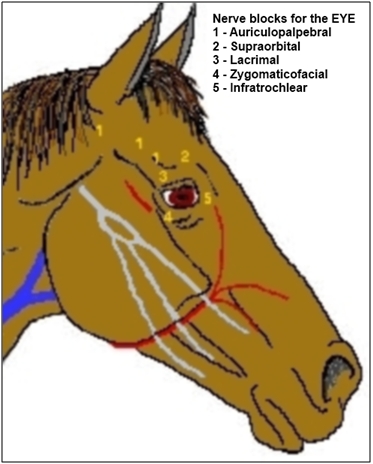
Answer: An auriculopalpebral (AP) nerve block and topical proparacaine
An auriculopalpebral (AP) nerve block and topical proparacaine will enable examination and treatment of the cornea. Sedation may also be necessary in very painful or nervous horses.
- The auriculopalpebral nerve innervates the orbicularis oculi muscles. Blocking this nerve allows the examiner to hold the eyelids open easily, even though the horse can still feel the lids.
- A supraorbital nerve block desensitizes the upper eyelid; this is very helpful in addition to an AP and topical.
- Instillation of a topical anesthetic such as proparacaine onto the cornea is vital to allow manipulation, scraping for cytology, and debridement.
- The infraorbital and maxillary nerve blocks do not block any part of the eye. A retrobulbar nerve block is used for enucleation.
- An intracameral injection places anesthetic into the anterior chamber. This is invasive and not necessary for an ophthalmic exam.
- See a diagram of the locations of these blocks, courtesy Dr. JG Adams.
- Refs: Muir, Hubbell, Bednarski, and Skarda’s Handbook of Veterinary Anesthesia, 4th ed. pp. 100-3, Muir and Hubbell’s Equine Anesthesia, 2nd ed. pp. 221-3.
Diagnostics
Progressively lengthening PR interval arrhythmia
In this type of arrhythmia, the P-R interval progressively gets larger until there is a dropped QRS complex (P wave without a QRS complex).
Answer and explanation
Answer: Second degree Mobitz type I heart block, also known as the Wenckebach beat
The correct answer is Second degree Mobitz type I heart block, also known as the Wenckebach beat. In a Mobitz type II block, the P-R interval duration is unchanged and occasionally you will observe a P wave without a QRS complex. These blocks are thought to be caused by a refractory AV node which is not responding to a delayed atrial depolarization. In a 1st degree heart block, you will observe an increased P-R interval and no dropped QRS. In 3rd degree heart blocks, the P waves are unassociated from the QRS complex.
Reproduction
Stallions unsuitable for breeding
Stallions which should definitely not be used for breeding?
Answer and explanation
Answer: stallion with a previous infection with Taylorella equigenitalis.
This organism is thought to be eradicated in the United States but is the causative agent of contagious equine metritis, which can lead to infertility (there is usually no clinically apparent disease in the stallion). It is okay to breed a stallion with a history of coital exanthema (Equine herpesvirus-3) as long as all lesions are cleared. A 180-degree rotation of the testicle is common and of no clinical significance as is a positive bacterial culture from a pre-ejaculate swab; however, heavy growth of Pseudomonas or Klebsiella may make you think twice, as they can be associated with causing endometritis in mares.