Overview
- Babesiosis is caused by intraerythrocytic protozoan parasites of the genus Babesia. Transmitted by ticks, babesiosis affects a wide range of domestic and wild animals and occasionally people. Although the major economic impact of babesiosis is on the cattle industry, infections in other domestic animals, including horses, sheep, goats, pigs, and dogs, assume varying degrees of importance throughout the world.
- Two important species in cattle—B bigemina and B bovis—are widespread in tropical and subtropical areas and are the focus of this discussion. However, because there are many common features of the diseases caused by different Babesia, much of this information can be applied to other species.
Transmission
Life Cycle
- The main vectors of B bigemina and B bovis are 1-host Rhipicephalus (Boophilus) spp ticks, in which transmission occurs transovarially. Although the parasites can be readily transmitted experimentally by blood inoculation, mechanical transmission by insects or during surgical procedures has no practical significance. Intrauterine infection has also been reported but is rare.
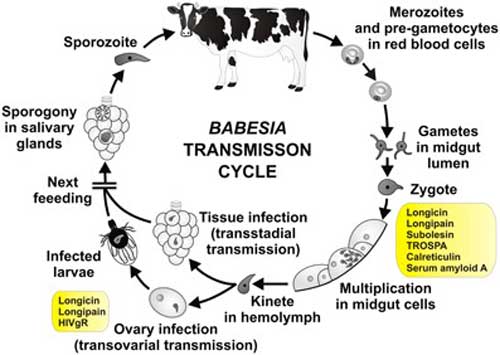
- In Rhipicephalus spp ticks, the blood stages of the parasite are ingested during engorgement and undergo sexual and asexual multiplication in the replete female, infecting eggs and subsequent parasitic stages. Transmission to the host occurs when larvae (in the case of B bovis) or nymphs and adults (in the case of B bigemina) feed. The percentage of larvae infected can vary from 0–50% or higher, depending mainly on the level of parasitemia of the host at the time the female ticks engorge. Under field conditions, the rate of tick transmission is generally higher for B bigemina than for B bovis.
Life cycle
- The parasite undergoes merogony in the bovine, and gamogony and sporogony in the tick. Sporozoites (Sz) injected into the bloodstream of a bovine during the blood meal of an infected tick, invade erythrocytes and differentiate into trophozoites (T), which divide asexually into usually two merozoites (M).
Clinical signs
- B bovis is a much more virulent organism than B bigemina. With most strains of B bigemina, the pathogenic effects relate more directly to erythrocyte destruction. With virulent strains of B bovis, a hypotensive shock syndrome, combined with generalized nonspecific inflammation, coagulation disturbances, and erythrocytic stasis in capillaries, contribute to the pathogenesis.
- The acute disease generally runs a course of ~1 wk. The first sign is fever (frequently ≥106°F [41°C]), which persists throughout, and is accompanied later by inappetence, increased respiratory rate, muscle tremors, anemia, jaundice, and weight loss; hemoglobinemia and hemoglobinuria occur in the final stages. CNS involvement due to adhesion of parasitized erythrocytes in brain capillaries can occur with B bovis infections. Either constipation or diarrhea may be present. Late-term pregnant cows may abort, and temporary infertility due to transient fever may be seen in bulls.
Treatment and control
- For treating cattle, diminazene is given IM at 3.5 mg/kg. For treatment, imidocarb is given SC at 1.2 mg/kg. At a dosage of 3 mg/kg, imidocarb provides protection from babesiosis for ~4 wk and will also eliminate B bovis and B bigemina from carrier animals.