- Parameters
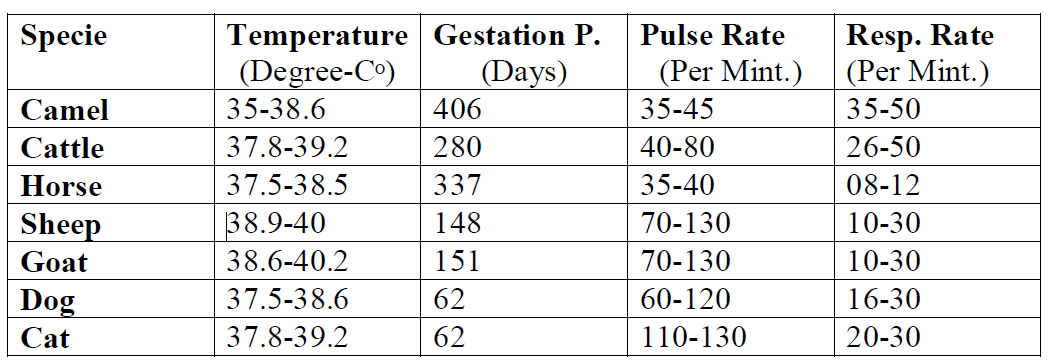
- Sheep
T 38.3–39.9 (100.9–103.8) , Pulse , HR , CRT , GIT movements - Goat
T 38.5–39.7 (101.3–103.5) , Pulse , HR , CRT , GIT movements - Camel
T , Pulse , HR , CRT , GIT movements - Cattle
T 38.0–39.3 (100.4–102.8),
- Mastitis vs Edema … types of mastitis
- Drenching pneumonia
- Dystocia
Diagnostic work-up
- Parasitic Diseases - Anemia, hypoproteinemia, electrolyte and acid-base abnormalities, azotemia, or hepatic and biliary enzyme elevation may be present depending on etiology.
- Skin Problems: Skin scraping or microscopic evaluation of crusts can provide a positive diagnosis and species identification in mange mite conditions. Potassium hydroxide preparation (10–20% KOH), allows identification of dermatophytes from skin.
- Cytological examination
Treatment and control
Dosage of Parasitic Diseases
- Nematodes
- Fenbendazole 10–20 mg/kg PO
◦ 20 mg/kg PO for 3 consecutive days if Trichuris
◦ 20 mg/kg PO for 5 days if Nematodirus - Albendazole 10 mg/kg PO (given only once)
- Ivermectin 0.2–0.3 mg/kg PO; 0.4–0.6 mg/kg if whipworms present
- Levamisole 5–8 mg/kg PO once
- Pyrantel pamoate 25 mg/kg PO for 3 days
Cestodes - Fenbendazole 50 mg/kg PO for 5 days
- Praziquantal 2–5 mg/kg PO
- Pyrantel pamoate 25 mg/kg PO for 3 days r Albendazole 10 mg/kg PO (given only
once) Trematodes - Clorsulon 7 mg/kg PO
- Albendazole 10 mg/kg PO (given only once)
- Fenbendazole 10–20 mg/kg PO
- Coccidia Treatment
- Sulfadimethoxine 55 mg/kg orally on day 1, followed by 22.5 mg/kg PO once daily for 5 days
- Ponazuril 20 mg/kg PO once (reportedly used 3 days in a row)
- Toltrazuril 20 mg/kg PO once (metabolized to ponazuril)
- Prevention
- Amprolium 5 mg/kg diluted in water for 21 days
- Decoquinate 0.5 mg/kg orally in feed for 28 days
- Pregnancy Toxemia
- Diarrhoea in sheep and goat
- Parasites of sheep and goat. Blood parasites.
- Anemia
- Lameness
- Pregnancy?
- Tympany and Bloat? Impaction? Differential Diagnosis?
- ruminal acidosis
- Acute ruminal acidosis is the most dramatic form of indigestion in ruminants and, in some cases, can lead to death in <24 hours. Subacute ruminal acidosis (SARA) results from chronic indigestion leading to short- or long-term production inefficiencies.
- Ruminal acidosis results from ingestion of excessive quantities of rapidly fermentable carbohydrates (RFC). Therefore, it represents a major challenge for ruminants on high-concentrate diets (e.g., feedlot cattle).
- Rumen pH of 4.5–5.0 and 5.2–5.5 are used as benchmarks for acute and chronic ruminal acidosis, respectively.
- Acute ruminal acidosis: Excessive consumption of RFC leads to a rapid fermentation with production of short-chain fatty acids and both D- and L-lactic acid. This causes a decrease in ruminal pH to physiologically inappropriate levels.
- Under low pH conditions, lactate-producing bacteria (e.g., Lactobacillus spp.) also grow faster, increase in number, and produce excessive amounts of D- and L-lactate.
- Treatment and control
- Rumen pH of 4.5–5.0 (normal 6.0–7.0 on roughage and 5.5–6.5 on grain).
- Magnesium hydroxide (500 g/450 kg body weight) can be administered once the rumen has been evacuated.
- Ringer’s solution or isotonic 0.9% saline at 20 mL/kg/h (highest rate reached through a 14-gauge catheter) is recommended for fluid replacement.
r Maintenance fluid rate: Recommended 2–4 mL/kg/h of lactated Ringer’s solutions or isotonic 0.9% saline. - Calcium, magnesium, and phosphates should be supplement to correct deficits.
- Cows with more severe acidemia (base deficits <10 mmol/L): Administer isotonic sodium bicarbonate (156 mmol/L).
- Bicarbonate requirements—calculate from values of base deficit (BD) obtained from the blood gas measurement. Bicarbonate (mmol) = body weight (kg) × base deficit (mmol/L) × 0.3.
- Analgesic and anti-inflammatory drugs—flunixin meglumine or meloxicam to decrease the effects of the systemic inflammatory response.
- Antimicrobials—oxytetracycline and penicillin (ceftiofur in camelids) can be administrated to prevent or treat bacteremia and liver abscess development.
- Broad-spectrum antimicrobial therapy can predispose to mycotic rumenitis.
- Prevention of polioencephalomalacia: Administer thiamine HCl (10 mg/kg, IM or IV q4h).
- Hypocalcemia in Small Ruminants Treatment and Control
- Hypomagnesemia - Treatment and Control
- Pox virus infection
- Sheep pox and goat pox result from infection by sheeppox virus (SPPV) or goatpox
virus (GTPV), closely related members of the genus Capripoxvirus in the family
Poxviridae. SPPV is mainly thought to affect sheep and GTPV primarily to affect goats, - ocular and nasal secretions, Lymph nodes aspiration,
- The disease in either species must be differentiated from the milder infection, contagious ecthyma (orf), which mainly causes crusty, proliferative lesions around the mouth.
- Fever and a variable degree of systemic disturbance develop. Eyelids become swollen, and mucopurulent discharge crusts the nostrils. Widespread skin lesions develop and are most readily seen on the muzzle, ears, and areas free of wool or long hair. Palpation can detect lesions not readily seen. Lesions start as erythematous areas on the skin and progress rapidly to raised, circular plaques with congested borders caused by local inflammation, edema, and epithelial hyperplasia.
- Sheep pox and goat pox result from infection by sheeppox virus (SPPV) or goatpox
- Caesarian section
Treatment and control
Dosage
-
Ketaconazole
-
Fluconazole
-
Iatraconazole
-
Atropine sulphate 0.25 mg/kg ; 1/3rd IV, rest IM
-
Oxytetracycline 20 mg/kg IM
-
Postparturient Haemoglobinuria: IV 60g Sodium acid phosphate in 300 ml distilled water and similiar dose s/c
-
Babesia: imidocarb (imizole) 2 mg/kg + Diminazine aceturate 12mg/kg bwt
-
CCPP: Tylosin 10 mg/kg
-
F. necrophorum - Sulfamethazine 150 mg/kg for 3-5 days
-
F hepatica: Triclabendazole 10mg/kg in sheep. albendazole 7.5 mg/kg ,
-
tapeworm: albendazole 10 mg/kg + prazoquantel 1mg/kg
-
Mastitis: TMP + sulphadiazine … Penicillin G intramammary . Anti-inflammatory therapy may include flunixin meglumine (1 mg/kg IV q12–24h, up to 3 days) or dexamethasone (0.44 mg/kg IM/SQ/IV, once).
-
HS: Ampicillin 10 mg/kg, Chloramphenicol 10 mg/kg,
-
Black leg: Procaine peniccilin 40,000 IU/kg
-
Cymelarsan
-
Buparavaquone
-
Interstitial Pneumonia
- Furosemide (1 mg/kg IM or IV, q24h or q12h).
- Flunixin meglumine (1.1–2.2 mg/kg IV, q24h or divided q12h).
- Dexamethasone (0.05 to 0.2 mg/kg IM or IV, once or twice).
- Antibiotics may be indicated to prevent secondary bacterial pneumonia.
-
Camel Pharmacology
- Antimicrobials
-
Sulfadimidine or sulfamethoxypyridazine are used at the dose of 55–70 mg/kg bw IV q24h.
Penicillin G dosage: 10,000–20,000 IU per kg bw, SQ or IM, q24h.
Long-acting penicillin (Procaine penicillin 150 mg/mL and benzathine penicillin 115 mg/mL) 20–30 mL/500 kg q72h.
Enrofloxacin 1.6–3 mg/kg bw, q12h (oral solution is used at 2.5 mg/kg). maximum dose of 5 mg/kg is used in cases of pasteurellosis or salmonellosis.
Oxytetracycline: 5–10 mg/kg bw IM q24h; long-acting tetracycline can be used at 20 mg/kg q48h.
Chloramphenicol: 10–30 mg/kg bw IM, q12h (not approved in many countries; illegal in Canada and the United States).
Streptomycin: 8 mg/kg bw IM, q12h.
Rifampin and erythromycin have also been used in camels for specific conditions at the same dosage and length of treatment as equines.
Gentamycin 3–4 mg/kg bw IM, q12h. Gentamycin is known to be extremely nephrotoxic in young camels and dehydrated animals.
Ampicillin: 4–8 mg/kg bw IV, q24h.
Tylosin 10 mg/kg bw q8h. -
Metronidazole: 5–10 mg/kg
Griseofulvin: 0.25 g/45 kg (not available in some countries; illegal for use in Canada and US).
Trimethoprim (2.7 mg/kg bw)/Sulfadiazine (13.3 mg/kg bw) daily IM or IV.
-
- Camel Anthelmintics and Other Antiparasitic Drugs
- All types of bovine anthelmintics can be used safely in camels at the same or slightly higher dosage.
Levamisole has been reported ineffective and possibly toxic in camels.
Oral: albendazole 7.5 mg/kg, oxfendazole 5–7.5 mg/kg,
Fenbendazole (6–7.5 mg/kg, morantel tartrate 35 g/500 kg bw).
Subcutaneous: ivermectin (0.2 mg/kg), moxidectin 0.15 mg /kg bw (helminths, suckling lice, and mange mites).
Pour On: ivermectin 5 mg/10 kg bw.
Monensin is very toxic and can be fatal in camels.
- All types of bovine anthelmintics can be used safely in camels at the same or slightly higher dosage.
- Deramatologic Infections
- Sedation
- Sedation and anesthesia
◦ Xylazine 0.25–0.5 mg/kg IM (0.1–0.25 mg/kg IV)
◦ Ketamine (3–5 mg/kg, IV) with xylazine ◦ Detomidine (25–75 μg/kg, IV)
◦ Butorphanol (0.05–0.1 mg/kg, IM).
Antiparasites: similar to bovine, do not use ionophores.
Antibiotics: similar to bovine, avoid aminoglycosides.
- Sedation and anesthesia
- Other Drugs
Diuretics: furosemide 0.25–1 mg/kg in the adult.
Topical ointments: similar dosages as in cattle.
Buparvaquone, treatment of theileriosis (125 mg/kg bw, IM repeat in 48–72h if necessary).
Trypanocide: bis(aminoethylthio)-4 metaminophenylarsine dihydrochloride (Cymelarsan® ): 25 mg/100 kg bw IM, safe in pregnant animals
- Antimicrobials
-
Blood Tests
- Parasites
- Bacterial
- Skin
-
Parameters
- Sheep
T 38.3–39.9 (100.9–103.8) , Pulse , HR , CRT , GIT movements - Goat
T 38.5–39.7 (101.3–103.5) , Pulse , HR , CRT , GIT movements - Camel
T , Pulse , HR , CRT , GIT movements - Cattle
T 38.0–39.3 (100.4–102.8),
- Sheep
-
Mastitis vs Edema … types of mastitis
-
Drenching pneumonia
-
Diarrhoea in sheep and goat
-
Anemia
-
Lameness
-
Pregnancy?
-
Caesarian section
-
Mastitis vs Edema … types of mastitis
-
Drenching pneumonia
-
Diarrhoea in sheep and goat
-
Anemia
-
Lameness
-
Pregnancy?
-
Caesarian section